
Sentence shortener turn long sentences into clear concise ones
A sentence shortener is a tool that trims a long, wordy sentence down to its essential meaning, without changing what it originally says. You type or paste in your sentence, and the tool removes filler words, redundant phrases, and unnecessary detail to hand you back a shorter, clearer version. Most sentence shorteners today run on AI, though you can shorten a sentence manually too, just by cutting the words that aren’t doing any real work.
Long sentences sneak up on almost every writer. You start with one idea, add a bit of context, then another clause, and before you know it, the sentence runs three lines long and the reader has lost the thread halfway through. A sentence shortener fixes that problem in seconds. Tools like the ones available on Tool Hub Zone can help simplify this process, giving you a shorter, cleaner, and easier-to-read version whether you’re writing an email, a blog post, an essay, or a caption for social media.
You’ll see this tool searched under a few different names and spellings too, sentence shortner, sentance shortener, sentence shorterner, shortener sentence, and more. They all point to the same thing: shrinking a sentence without losing what it’s trying to say.
What Is a Sentence Shortener
A sentence shorten is a writing tool that reduces the length of a sentence while keeping its core meaning intact. It works by identifying words and phrases that add length without adding value, things like filler words, repeated ideas, and overly formal padding, then removing or rewording them.
The idea behind sentence shortening isn’t new. Editors and writing teachers have taught “cut the fat” as a writing rule for decades. What’s changed is the speed. Where a human editor might take a few minutes to tighten a sentence by hand, an AI sentence shortener does it almost instantly, and it can process dozens of sentences in the time it takes to edit one manually.
At its core, sentence shortening sits alongside a handful of related ideas: sentence reduction, word reduction, and content shortening. All of these describe the same general goal, saying more with less.
How Does an AI Sentence Shortener Work
An AI sentence shortener works by analyzing the grammar, structure, and meaning of a sentence before rewriting it in a shorter form. This is powered by natural language processing (NLP), a branch of artificial intelligence that lets software understand how words relate to each other in a sentence, not just what the words are, but what job each one is doing.
When you enter a sentence, the AI writing tool breaks it into parts: subject, verb, object, and any supporting clauses. It then identifies which parts are essential to the meaning and which parts are filler, repetition, or unnecessary qualifiers. From there, it rebuilds the sentence using fewer words while keeping the grammar correct and the meaning unchanged.
This is different from just deleting random words. A well-built AI sentence rewriter or AI text editor understands context. It knows that removing “in order to” and replacing it with “to” changes nothing about the meaning, but removing a key noun would. That contextual understanding is what separates a good sentence shorten from a basic find-and-replace script.
Some tools also let you pick a tone, formal, casual, academic, or professional, so the shortened sentence still fits the voice of whatever you’re writing.
How to Shorten a Sentence (Step-by-Step)
Shortening a sentence, whether you’re using a tool or doing it by hand, usually follows the same basic process.
If you’re doing this manually instead of using a shorten sentence generator, the process is similar, you just do steps 3 and 4 yourself, one word or phrase at a time.
Sentence Shortener vs Summarizer vs Paraphraser vs Simplifier
These four tools get mixed up constantly, and honestly, the confusion is fair since they all involve rewriting text. But they solve different problems.
|
Tool |
What It Does |
Best For |
Output vs Input |
|---|---|---|---|
|
Sentence Shortener |
Cuts unnecessary words from a single sentence while preserving the same meaning |
Trimming wordy lines in emails, essays, or captions |
Shorter, same core idea |
|
Text Summarizer |
Condenses a full paragraph, article, or document down to its key points |
Summarizing long articles, reports, or research papers |
Much shorter, high-level only |
|
Paraphrasing Tool |
Rewrites a sentence using different words and sentence structure |
Avoiding repetition, changing tone, reducing plagiarism risk |
Roughly the same length, different wording |
|
Sentence Simplifier |
Breaks down complex grammar and vocabulary into plain language |
Making technical or academic writing easier to read |
Similar or shorter, simpler structure |
So, is sentence shortening the same as paraphrasing? Not quite. A sentence rewriter or paraphrasing tool focuses on changing the wording, the sentence might stay roughly the same length. A sentence shortener focuses on cutting length first, wording second. And a sentence summarizer works on a bigger scale entirely, condensing whole paragraphs rather than individual lines. [internal link opportunity: paraphrasing tool guide]
How to Shorten a Sentence Without AI (Manual Techniques)
Not everyone wants to run their writing through an AI tool, and that’s completely fair. If you’re searching for a sentence shorten no AI option, or you just want to learn the skill yourself, here’s how editors have shortened sentences by hand for years.
Start by reading your sentence out loud. If you run out of breath before it ends, it’s probably too long. From there, look for these common culprits:
This manual method takes longer than using a shorten sentences online tool, but it also builds a habit. Once you start spotting these patterns, you’ll naturally write tighter sentences the first time, without needing to shorten them later.
How to Shorten a Sentence Without Losing Meaning
The real challenge in sentence shortening isn’t cutting words, it’s cutting the right words. Anyone can make a sentence shorter by deleting things at random. The skill is in keeping every piece of information the reader actually needs.
A good rule of thumb: before you cut a word or phrase, ask if the sentence still makes complete sense without it. “She quickly ran to the very large store” can lose “quickly” and “very” without losing any real information. But “she ran to the store to buy medicine for her sick child” can’t lose “for her sick child” without losing the reason the sentence exists in the first place.
This is also where AI sentence shorteners can occasionally get it wrong. If a tool over-shortens a sentence and strips out something important, don’t just accept the output, edit it back in. The goal is always concise sentences that keep their full meaning, not just short sentences for the sake of being short.
Shortening Sentences for Academic Writing
Academic writing comes with its own rules, so shortening a sentence for an essay or research paper takes a slightly different approach than shortening a casual email.
Most academic writing has strict word limits, whether it’s a 250-word abstract or a 3,000-word essay. When you’re over the limit, sentence shortening is often the fastest way to get back under it without cutting entire arguments. Focus on trimming introductory phrases (“it is important to note that,” “it should be mentioned that”) since these rarely carry real academic weight. Also watch for stacked prepositional phrases, a common habit in formal writing that adds length without adding precision.
Keep in mind that academic tone usually needs to stay formal even after shortening. A sentence shortener with a tone option set to “academic” or “formal” will usually preserve that register better than a generic default setting. And if you’re shortening a sentence with a citation or specific data point in it, always double-check that the number, date, or source reference survives the edit.
Why Shorter Sentences Improve Readability
Shorter sentences are easier to read because they ask less of the reader’s working memory at any one time. Readability research generally points to somewhere around 15 to 20 words as a comfortable average sentence length for general audiences, though this varies by subject matter and audience expertise. Sentences that consistently run past 25 to 30 words tend to slow readers down, even when the grammar is technically correct.
This matters more online than it ever did in print. Readers scanning a blog post, a product page, or a social media caption are moving fast, and a wall of long sentences gives them a reason to leave. Shorter, clearer sentences keep people reading, which is part of why sentence shortening has become a standard step in content editing and copy editing workflows, not just an academic exercise.
A sentence shorten can improve readability, but it’s worth saying plainly: it’s a tool that helps, not a guarantee. A shortened sentence still needs a human check to make sure it reads naturally and fits the context.
Common Mistakes People Make When Shortening Sentences
A few mistakes come up again and again when people try to shorten sentences, whether by hand or with a tool.
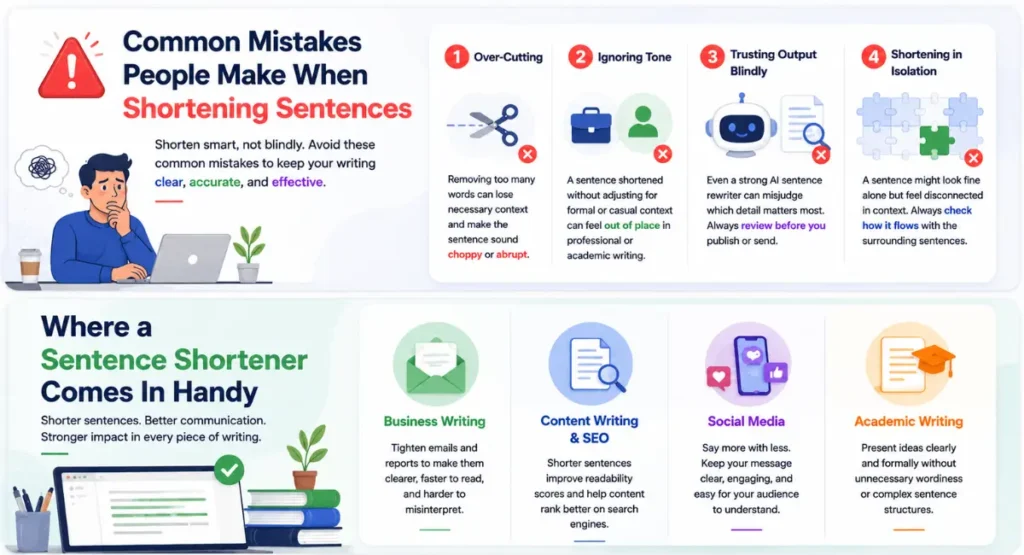
The most common one is over-cutting, removing so many words that the sentence loses necessary context or starts to sound choppy and abrupt. The second is ignoring tone, a sentence shortened without adjusting for formal or casual context can suddenly feel out of place in a professional email or academic paper. The third is trusting the output blindly. Even a strong AI sentence rewriter can occasionally misjudge which detail matters most, so it’s worth a quick read-through before you hit publish or send.
A smaller but common mistake is shortening a sentence in isolation without checking how it flows with the sentences around it. A sentence can be perfectly fine on its own and still feel disconnected once it’s been trimmed, so it’s worth rereading the full paragraph after editing, not just the single line.
Where a Sentence Shortener Comes In Handy
Sentence shortening isn’t just for students or professional editors, it shows up in everyday writing more than most people realize.
In business writing, tightening sentences in emails and reports makes communication faster to read and harder to misinterpret, which matters when you’re writing to clients or coworkers who are skimming their inbox. In content writing and SEO, shorter sentences tend to perform better for readability scores, and search engines increasingly favor content that’s easy to scan, which is part of why sentence shorteners have become a regular part of many writers’ editing process. On social media, character limits make a sentence shortener genuinely practical, cutting a caption down without losing its point can be the difference between a post that gets read and one that gets scrolled past.
Most sentence shortener tools today work directly in the browser, so there’s nothing to install and no software required. That makes them just as usable on a phone during a quick email reply as on a desktop while editing a full article.
What Makes the Best Sentence Shortener?
There’s no single tool that’s objectively the best sentence shorten for everyone, it depends on what you’re shortening and how often you’re doing it. That said, a few things separate a genuinely useful tool from a mediocre one.
Accuracy comes first: does the shortened sentence still say exactly what the original said? A tool that trims words but drifts from the original meaning isn’t actually saving you time, since you’ll end up rewriting it anyway. Tone flexibility matters too, a sentence shortener that only produces one style of output won’t work well across academic writing, business emails, and casual social posts. Speed and simplicity also count, the best tools let you paste text and get a result in a couple of clicks, without needing an account or a learning curve.
If you’re looking for a free sentence shortener, most reputable tools offer a solid free tier with a character limit, with paid plans unlocking longer inputs, more tone options, or unlimited use. Whether you go with an AI-powered option or want a sentence shortener no AI approach and prefer to learn the manual technique instead, the end goal is the same: sentences that say what you mean, in fewer words.