
What Is an Ad Copy Writer? A Complete Guide to the Job, Skills, and Getting Paid to Write Ads
If you’ve ever read an ad and felt like it was talking directly to you, that wasn’t luck. Someone sat down, thought about what would make you stop scrolling, and wrote it that way on purpose. That someone is an ad copy writer, and it’s one of the more practical, in-demand writing careers right now, whether you want to freelance, join an advertising agency, or just write better ads for your own business.
This guide breaks down what the role actually involves, what it pays, and where AI tools fit into the picture now. If you’d rather try writing a draft yourself before reading further, Tool Hub Zone has a free ad copy generator among its collection of tools, and it’s a decent way to see a first draft in seconds before you apply the tips in this guide to sharpen it.
What Does an Ad Copy Writer Actually Do?
An ad copy writer’s day usually starts with research, not writing. Before a single headline gets typed, they’re looking at who the audience is, what problem the product solves, and what competitors are already saying in their own ads. Only after that does the actual writing start.
A typical ad writer job description includes writing headlines, primary text, descriptions, and calls to action, then testing multiple versions against each other. The output is short, but short doesn’t mean easy. A Google search ad headline is capped at 30 characters. A Facebook ad gives more room, but the scroll-past instinct is brutal, so every word still has to earn its place. Most job listings for this role also expect basic comfort with performance data, since a huge part of the job is figuring out which version of an ad actually worked, not just writing something you personally think sounds good.
Here’s how the role compares to nearby titles, since they get used loosely online and in job postings:
|
Role |
Main Focus |
Typical Platforms |
Core Skill |
|---|---|---|---|
|
Ad Writer |
Writing ad text broadly (any format) |
Google, Facebook, print, video scripts |
Persuasion, brevity |
|
Ad Copy Writer |
Short-form conversion copy specifically |
Google Ads, Facebook Ads, Instagram Ads, PPC |
Headlines, CTAs, hooks |
|
Advertising Copywriter |
Broader ad campaigns, sometimes including strategy |
Agency campaigns across channels |
Concept, persuasion, brand fit |
|
General Copywriter |
Brand voice, long-form, websites, emails |
Websites, email, blogs, brochures |
Storytelling, brand tone |
Ad Writer vs Copywriter: What’s the Difference?
An ad writer and a general copywriter aren’t the same thing, even though the terms get used interchangeably in job postings. An ad writer, sometimes called an advertising copywriter, focuses specifically on advertisements: short, high-pressure copy meant to get an immediate action. A general copywriter’s job is broader and can include website pages, email sequences, product descriptions, and brand messaging that doesn’t need to convert in the next ten seconds.
Think of it this way. A copywriter might spend a week writing a homepage. An ad copy writer might spend that same week testing forty different three-line ad variations. Both are writers, but the muscles they use are different. One leans on structure and flow. The other leans on speed, specificity, and constant testing against real click data.
Key Skills Every Professional Ad Copy Writer Needs
Good ad copywriting isn’t really about vocabulary. It’s about restraint. The best ad copy writers know how to cut a sentence down until only the part that actually persuades is left standing, and this is one of the core copywriting skills that separates a professional ad writer from someone who just writes catchy lines.
Understanding the target audience matters more than almost anything else on this list. If you don’t know who you’re writing for, you’re just guessing at what will land. Alongside that, a solid ad copy writer understands basic consumer psychology, things like urgency, social proof, and specificity, because vague claims don’t convert nearly as well as concrete ones. Platform literacy also matters a lot. Writing for Google Ads means working inside strict character limits and keyword relevance rules, while writing for Instagram or Facebook ads means writing something that feels native to a scroll, not like an interruption.
Data comfort is another skill that separates hobbyists from working professionals. Ad copy writers who understand click-through rate, cost per click, and basic A/B testing results can actually improve their own work over time instead of guessing. This is also where a professional ad copy writer earns trust with clients: showing that a headline change lifted CTR by a measurable amount matters more than any claim about “creative talent.”
Where Ad Copy Writers Work: Platforms, Agencies, and Freelance
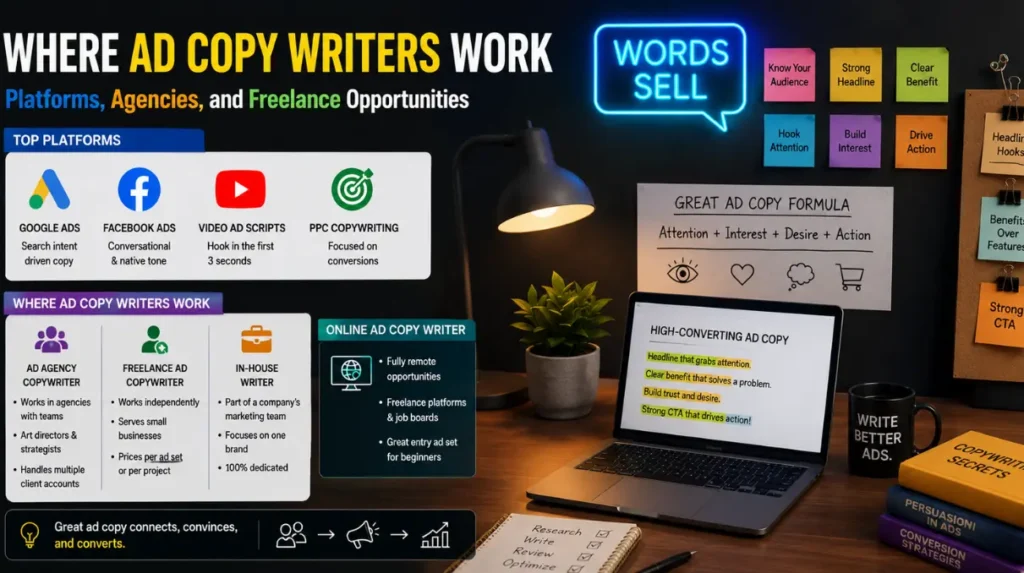
Most working ad copy writers split their time across a handful of platforms, and each one has its own quirks. Google Ads copy is search-intent driven and tightly limited on character count, so keyword placement and clarity matter more than creativity. A Facebook ad writer, on the other hand, usually has more room to work with and gets rewarded for a conversational, native-feeling tone over a hard sell. Video ad scripts, sometimes handled by a dedicated ad script writer, need to hook attention in the first three seconds or the viewer skips past.
There’s also steady demand in PPC copywriting specifically, where the writer works closely with a performance marketing team and gets judged almost entirely on conversion numbers rather than creative flair.
There’s also steady demand in PPC copywriting specifically, where the writer works closely with a performance marketing team and gets judged almost entirely on conversion numbers rather than creative flair.
On the employment side, this role splits roughly three ways. An ad agency copywriter works inside a copywriting or marketing agency, usually on a team with art directors and strategists, and handles multiple client accounts at once. A freelance ad copywriter (also called a freelance advertising copywriter) works independently, often serving small businesses that can’t afford full agency retainers, and typically prices work per ad set or per project. In-house writers sit inside a single company’s marketing team and focus entirely on that brand’s ads. Online ad copy writer roles, meaning fully remote positions found through freelance platforms or job boards, have become one of the more common entry points into the field, especially for beginners building a portfolio.
How to Write Ad Copy That Converts (Formulas & Real Tips)
Writing an ad that converts starts with knowing your audience better than they know themselves, at least on the topic your product touches. Before writing a single line, look at reviews, forum posts, or customer support tickets if you have access to them. That’s where the real language your audience uses shows up, and it’s almost always better than anything you’d invent on your own.
From there, the headline carries most of the weight. It has to stop the scroll or answer the search intent immediately, and specificity beats cleverness almost every time. “Lose 5 pounds in 3 weeks” will usually outperform “Transform your body today,” because the first one is a promise and the second one is a slogan. This principle goes back to classic advert copywriting theory. Claude Hopkins, one of the earliest voices in modern advertising copy, argued that specific, testable claims beat vague enthusiasm, and Gary Bencivenga, a more recent direct-response legend, built his whole career on the same idea: proof and specificity sell, adjectives don’t.
The call to action deserves more thought than it usually gets. “Learn More” is fine, but “Get My Free Quote” or “Start My 7 Day Trial” gives the reader a clearer picture of what happens next, which reduces hesitation. A few reliable ad copy formulas worth learning early are hook-benefit-proof-CTA, problem-agitate-solution, and before-after-bridge. These aren’t rigid templates so much as starting frameworks, and most working writers eventually adapt them into their own shorthand.
Content writing for advertisement purposes also looks different depending on the industry. Advertisement content writing for a consumer product can lean emotional and punchy, while technical writing for advertisement in fields like software, finance, or industrial equipment needs to stay accurate and specific, since overselling a technical claim can create real problems for the client later. Keep the ad short wherever the platform allows it. Readers skim, and every unnecessary word is a chance for them to lose interest before reaching your CTA.
How Much Do Ad Copy Writers Earn? Getting Paid to Write Ads
People searching for how to get paid to write ads usually want a straight answer, and the honest one is that pay varies a lot by experience, platform, and client type. Beginners typically charge per ad set (a headline plus a few description and CTA variations) rather than by the hour, since hourly billing is hard to justify on work that might take twenty minutes once you’re fast. As writers build a track record, many shift to per-project or monthly retainer pricing, especially once they’re handling ongoing PPC accounts for a client.
Ad copywriting services are usually sold in one of three ways: as a one-off package (a set number of ad variations for a flat fee), as a monthly retainer for ongoing campaign support, or as part of a broader copywriting marketing agency’s service bundle alongside SEO or social media content. There are also niche pockets of this work worth knowing about. Copywriting for Amazon ads, for instance, is its own specialty, since Amazon’s ad formats and search behavior work differently from Google or Facebook, and writers who understand Amazon’s specific ranking and conversion factors can charge accordingly for that expertise.
How to Become an Ad Copy Writer (Career Path & Portfolio)
There’s no single required degree for this job, which is part of why it attracts so many career changers. What actually gets people hired is a portfolio that shows real ad examples, even if those examples are self-initiated practice pieces for a fake or real product.
A common starting path looks like this: pick three or four products you like, write full ad sets for each (headline, description, CTA, plus two or three variations), and put them together as a simple portfolio site or PDF. From there, freelance platforms and small business owners are usually the easiest entry point, since bigger advertising agencies often want to see prior client work first. [internal link opportunity: freelance copywriting portfolio guide]
Agencies, on the other hand, usually hire ad copy writers into a broader marketing or content team, working alongside PPC specialists and social media managers, and often expect at least some prior client or internship experience before bringing someone on full time.
AI Ad Copy Writers, Generators, and Templates: Do They Replace Humans?
AI ad copy writers, including free tools built into general assistants and standalone ad copy generators, are genuinely useful for speed. They’re good at producing first drafts, generating headline variations quickly, and getting past a blank page. A free AI ad writer tool can be a solid starting point for beginners who aren’t sure how to structure their first ad set, and there are also ad copy templates available online that lay out proven formulas like problem-agitate-solution for anyone who wants a starting skeleton rather than a blank page.
What these tools are still not reliably good at is understanding a specific brand’s voice, reading between the lines of what a client actually wants, or making the judgment call about which angle will resonate with a particular audience. The best AI ad copy writer tool for any given person really depends on their workflow rather than any single “best” answer, since some are built into ad platforms directly (like ad suggestion features inside Google Ads Editor or Meta Ads Manager) while others are separate generator tools.
In practice, most professional ad copy writers now use AI as a starting point rather than a replacement. A tool might generate ten headline options in a few seconds, and the writer’s actual job becomes picking the two that fit the brand and sharpening them further. That’s a real shift in the workflow, but it hasn’t removed the need for a human who understands persuasion and audience psychology. Google Ads Editor help documentation
Ad Copy Examples That Actually Work
A strong headline usually names the outcome directly instead of describing the product. Something like “Cut Your Grocery Bill by 20% This Month” works because it’s specific and immediate, not because it’s clever.
A strong CTA gives the reader a clear next step with almost no friction attached to it. “Start Free, No Card Needed” removes the objection before it even forms in the reader’s head.
A strong hook, especially for video or social ads, usually opens mid-conversation rather than with an introduction. “Nobody tells you this about home insurance” pulls curiosity forward instantly, compared to a flat opener like “Learn about our insurance plans.”